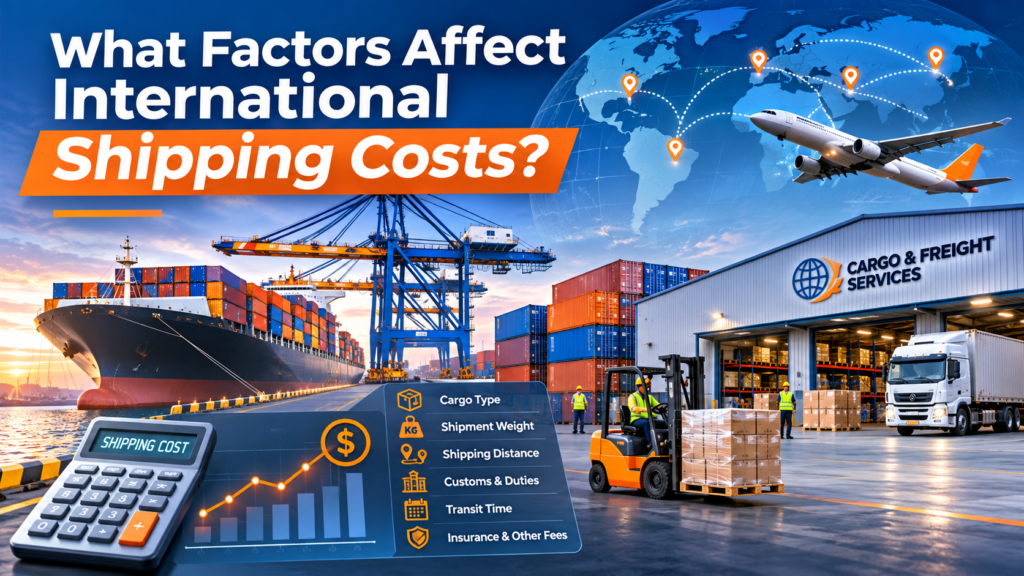
International shipping costs vary depending on the cargo, transportation method, destination, shipment size and the services required to move goods across borders. A small air cargo shipment may be priced differently from a full container of commercial goods, even when both shipments travel internationally.
For importers and exporters, understanding shipping costs is important for budgeting, calculating product prices, planning inventory and choosing the right transportation method. A freight quotation may include several charges beyond the main transportation fee, such as origin handling, documentation, customs clearance, destination charges and final delivery.
The total cost of an international shipment depends on how the cargo moves, where it is going, how it is packaged and which logistics services are required.
In this guide, we explain the major factors that affect international shipping costs, how freight charges are calculated, what additional fees businesses should consider and how to make international shipping more cost-efficient.
What Are International Shipping Costs?
International shipping costs are the expenses associated with transporting goods from one country to another. They may include transportation charges, cargo handling, documentation, customs-related services, insurance and other logistics expenses.
The exact cost depends on the shipping arrangement and the services included in the quotation.
For example, an exporter shipping goods from Pakistan to the United Kingdom may need to arrange:
- Cargo pickup from the warehouse.
- Export documentation.
- Export customs clearance.
- Transportation to the port or airport.
- Air freight or ocean freight.
- Destination handling.
- Import customs clearance.
- Delivery to the buyer’s location.
Some of these services may be included in a freight quotation, while others may be charged separately.
The main freight rate is not always the total cost of getting goods to their final destination. Importers and exporters should review the complete shipment cost before confirming a booking.
What Factors Affect International Shipping Costs?
International shipping rates are influenced by multiple factors. The following are the most important considerations when estimating the cost of transporting cargo overseas.
1. Shipping Method
The transportation method is one of the most significant factors affecting international shipping costs.
Businesses generally use air freight, sea freight, road freight, rail freight or a combination of transportation modes.
Each method has a different pricing structure, transit time, capacity and handling requirements.
Air Freight
Air freight is commonly used for urgent shipments, high-value goods, product samples, spare parts and cargo that requires relatively fast transportation.
Air cargo rates are influenced by chargeable weight, route, airline capacity, shipment dimensions and applicable surcharges.
Air freight is generally more expensive than ocean freight for comparable large-volume shipments, but it can reduce transportation time on many routes.
Sea Freight
Sea freight is commonly used for commercial goods, machinery, raw materials, furniture, textiles and other cargo suitable for ocean transportation.
Businesses may choose sea freight for larger shipments because ocean transportation can offer a lower freight cost per unit of cargo compared with air freight, depending on the route and shipment characteristics.
Sea freight includes options such as Full Container Load (FCL) and Less Than Container Load (LCL).
Road Freight
Road freight is used for domestic transportation, cross-border cargo movement, container transportation and delivery to or from ports, airports and warehouses.
Road freight costs depend on distance, vehicle type, cargo weight, route, fuel, tolls and other transportation requirements.
Rail Freight
Rail freight may be used for domestic or international cargo transportation where rail services and infrastructure are available.
Rail costs depend on route, cargo type, volume, handling requirements, service availability and other operational factors.
The best transportation method depends on the shipment’s budget, cargo characteristics, destination and delivery requirements.
2. Cargo Weight and Dimensions
Cargo weight and dimensions directly affect shipping costs because transportation providers must allocate space, capacity and handling resources to the shipment.
A shipment may be priced based on actual weight, dimensional weight or another applicable freight calculation method.
Actual Weight
Actual weight is the physical weight of the shipment, including packaging, measured using the applicable carrier requirements.
For example, a shipment weighing 250 kilograms may be priced according to its weight when the applicable freight rate is based on actual weight.
Volumetric Weight
Volumetric weight, also called dimensional weight, considers the space a shipment occupies rather than only its physical weight.
This is particularly important for air freight and express shipments involving bulky, lightweight cargo.
A commonly used air freight volumetric weight formula is:
Volumetric Weight (kg) = Length × Width × Height ÷ 5,000
The dimensions are measured in centimetres. However, the divisor may vary according to the carrier, service or quotation rules.
For example, consider a shipment measuring:
- Length: 100 cm
- Width: 80 cm
- Height: 60 cm
Using a divisor of 5,000:
100 × 80 × 60 ÷ 5,000 = 96 kg
The shipment’s volumetric weight would be 96 kg under this calculation.
If its actual weight is 70 kg, a carrier using this formula and the greater of actual or volumetric weight would generally calculate the chargeable weight as 96 kg.
If the actual weight is higher than the volumetric weight, actual weight may be used instead.
Always confirm the applicable formula with the carrier or freight forwarder.
3. Shipping Distance and Destination
The distance between the origin and destination can affect international shipping costs.
However, distance alone does not determine the freight rate. Route availability, transportation infrastructure, carrier capacity, port or airport handling, transshipment requirements and destination accessibility also influence pricing.
Shipping cargo to a major international port may involve different costs from shipping cargo to a location requiring additional inland transportation.
Destination-related factors may include:
- Port or airport availability.
- Distance from the destination terminal.
- Inland transportation requirements.
- Remote-area delivery.
- Customs procedures.
- Local handling charges.
- Transportation infrastructure.
- Route availability.
For example, a shipment arriving at a major port may still require trucking to a warehouse located inland. The inland transportation charge must be considered separately if it is not included in the quotation.
4. Cargo Type and Handling Requirements
The type of goods being shipped can influence transportation costs.
Some cargo can be handled through standard freight services, while other goods require additional equipment, handling procedures, documentation or regulatory compliance.
Cargo categories that may require special arrangements include:
- Fragile goods.
- Heavy machinery.
- Oversized cargo.
- Temperature-sensitive products.
- Perishable goods.
- Dangerous goods.
- High-value cargo.
- Cargo requiring special packaging.
For example, temperature-sensitive products may require refrigerated transportation or temperature-controlled storage.
Dangerous goods may require specific classification, packaging, labeling, documentation and handling procedures.
Oversized machinery may require special loading equipment, transport planning or additional handling.
These requirements can increase the total shipping cost.
5. Fuel Prices and Fuel Surcharges
Fuel costs affect the operating expenses of airlines, shipping lines, trucking companies and other transportation providers.
When fuel prices or related operating costs change, carriers may adjust freight rates or apply fuel-related surcharges.
Fuel surcharges may be calculated according to the carrier’s pricing policy and can vary by transportation mode, route, service and market conditions.
For example, air freight quotations may include a fuel surcharge calculated separately from the base freight rate.
Ocean freight quotations may also include fuel-related adjustments depending on the carrier, route and service arrangement.
Because fuel-related charges can change, businesses should confirm whether they are included in the quotation or charged separately.
6. Shipping Route and Transshipment
The shipping route affects transportation cost, transit time and the logistics arrangements required to move cargo.
Some shipments travel through direct routes, while others require transshipment through intermediate ports, airports or logistics hubs.
Transshipment occurs when cargo is transferred from one transportation service to another before reaching its final destination.
A route involving multiple transportation stages may require additional handling, coordination and transportation charges.
Route-related cost factors include:
- Direct or indirect transportation routes.
- Transshipment requirements.
- Carrier availability.
- Port or airport handling.
- Inland transportation.
- Route disruptions.
- Service frequency.
A direct route may reduce the number of transportation stages, but it is not always the cheapest option. Freight rates depend on the carrier, route, cargo and available services.
7. Shipping Season and Market Demand
International shipping rates can change according to seasonal demand and market conditions.
When demand for cargo transportation increases, available capacity may become limited. Carriers may adjust their pricing, service availability or surcharges.
Demand can be influenced by:
- Seasonal retail demand.
- Holiday periods.
- Agricultural export seasons.
- Manufacturing cycles.
- Large trade events.
- Market disruptions.
- Changes in carrier capacity.
- Port congestion.
For example, businesses importing inventory before major retail sales periods may need to book shipments earlier because transportation capacity and schedules can become more constrained.
Seasonal demand can affect both transportation costs and shipment planning.
8. Port, Terminal and Handling Charges
International shipments may involve charges associated with cargo handling at ports, airports, warehouses and terminals.
These charges depend on the transportation arrangement, cargo type, terminal, service provider and shipment requirements.
Potential charges may include:
- Terminal Handling Charges (THC).
- Cargo handling fees.
- Container handling charges.
- Warehouse charges.
- Loading and unloading charges.
- Documentation fees.
- Cargo inspection-related handling.
- Storage charges.
These charges may apply at the origin, destination or both.
For ocean freight, terminal handling charges can form part of the overall cost of moving cargo through the port.
For air freight, cargo terminal handling and other airport-related charges may also be applicable.
Businesses should confirm which handling charges are included in their freight quotation.
9. Customs Duties and Taxes
Customs duties and taxes can significantly affect the total cost of importing goods.
However, they are not necessarily part of the freight charge itself. They are separate expenses associated with the importation of goods and the destination country’s regulations.
Import duties and taxes may depend on:
- Product classification or HS code.
- Customs valuation.
- Country of origin.
- Applicable trade agreements.
- Import regulations.
- Product-specific requirements.
- Destination-country tax rules.
Customs authorities determine applicable duties, taxes and regulatory requirements under the relevant laws.
A freight forwarder or customs broker may assist with customs documentation, declarations and clearance coordination, depending on the agreed services.
Importers should calculate customs-related costs separately when estimating the total expense of receiving international cargo.
10. Cargo Insurance
Cargo insurance can affect the total shipping cost because it may involve an additional premium for coverage against certain risks during transportation.
The cost of cargo insurance may depend on:
- Cargo value.
- Cargo type.
- Transportation method.
- Route.
- Coverage scope.
- Applicable risks.
- Insurance provider.
- Policy conditions.
Cargo insurance is not automatically included in every freight quotation.
Businesses should review the policy terms, exclusions, limits and conditions before deciding whether the coverage meets their requirements.
Insurance can be particularly relevant when shipping high-value goods, machinery, commercial inventory or cargo that could result in substantial financial losses if damaged or lost.
11. Packaging and Cargo Preparation
Packaging can influence shipping costs because it affects cargo weight, volume, handling requirements and transportation suitability.
Large packaging dimensions may increase the volumetric weight of an air shipment or the volume occupied by an LCL shipment.
Poor packaging may also increase the risk of damage and require additional handling.
Packaging-related costs may include:
- Cartons.
- Wooden crates.
- Pallets.
- Protective materials.
- Shrink wrapping.
- Cargo securing.
- Export packaging.
- Special packaging for fragile goods.
- Packaging required for specific cargo regulations.
Businesses can review their packaging design to reduce unnecessary space while maintaining adequate cargo protection.
However, packaging should not be reduced in a way that compromises cargo safety or applicable shipping requirements.
12. Shipment Size and Container Type
The size of the shipment can affect the freight cost, particularly in ocean freight.
Businesses shipping smaller quantities may use LCL services, while larger shipments may use FCL transportation.
LCL Shipping
Less Than Container Load (LCL) involves consolidating cargo from multiple shippers into a container.
LCL freight costs may depend on cargo volume, weight, handling requirements, consolidation arrangements and destination charges.
It can be suitable for businesses that do not have enough cargo to book a full container.
FCL Shipping
Full Container Load (FCL) involves booking a container for a shipment under an FCL arrangement.
FCL freight costs may depend on container size, container type, route, carrier, market conditions and other charges.
Common container options may include 20-foot and 40-foot containers, subject to availability and cargo suitability.
Specialized containers may be required for certain goods, such as temperature-sensitive cargo or cargo requiring specific equipment.
The choice between FCL and LCL depends on cargo volume, costs, handling requirements and shipment planning.
13. Delivery Service and Final Destination
The delivery service selected can affect the total international shipping cost.
Some shipments are transported from the origin to a port or airport, while others require transportation to the final delivery address.
Depending on the arrangement, the freight quotation may include:
- Factory or warehouse pickup.
- Origin inland transportation.
- International transportation.
- Destination handling.
- Customs clearance.
- Inland delivery.
- Residential or commercial delivery.
- Special delivery arrangements.
Door-to-door cargo services may involve several logistics activities within a single service arrangement.
Businesses should confirm the exact delivery scope, including whether customs clearance, duties, taxes and destination charges are included.
14. Freight Rate Type and Booking Timing
Freight rates can vary depending on the type of booking arrangement and the timing of the shipment.
Some businesses use spot rates for individual shipments, while others may have contractual rates based on recurring shipment volumes or agreed commercial terms.
Freight rates may be affected by:
- Carrier capacity.
- Shipment frequency.
- Route.
- Booking timing.
- Contract arrangements.
- Market demand.
- Service level.
- Rate validity.
Businesses with regular shipment volumes may discuss longer-term transportation arrangements with their freight forwarder or carrier.
However, the availability and suitability of contracted rates depend on the shipment, route, carrier and commercial agreement.
What Charges Are Included in International Shipping Costs?
International shipping quotations may include multiple charges beyond the main freight rate.
The exact charges depend on the shipment and the services included.
| Cost component | What it covers |
|---|---|
| Origin pickup | Transportation from the shipper’s location to the shipping facility |
| Origin handling | Cargo handling at the origin terminal, warehouse or facility |
| Export documentation | Preparation or processing of relevant shipping documents |
| Export customs clearance | Customs-related services for the export shipment, where included |
| Main freight | International transportation by air, sea or another transport mode |
| Fuel surcharge | Fuel-related adjustment applied by a carrier or service provider |
| Terminal handling | Handling charges associated with terminals or cargo facilities |
| Destination handling | Cargo handling at the destination facility |
| Import customs clearance | Customs brokerage or clearance services, where included |
| Duties and taxes | Import charges assessed under destination regulations |
| Cargo insurance | Premium for agreed cargo insurance coverage |
| Inland delivery | Transportation from the destination facility to the final address |
| Storage | Charges for cargo stored beyond applicable free periods or under other storage arrangements |
| Additional services | Special handling, packaging, inspection-related services or other applicable charges |
Not every quotation includes all these components.
Before confirming a shipment, request a breakdown of the charges and clarify which costs are included, excluded or payable separately.
How to Calculate the Total Cost of an International Shipment
The total international shipping cost should include the transportation and logistics expenses required to move the cargo through the agreed shipment arrangement.
A simplified cost calculation is:
Total Shipping Cost = Origin Costs + Main Freight + Destination Costs + Customs Duties and Taxes + Insurance + Additional Charges
For a broader landed-cost calculation, businesses may also include the purchase price of the goods, overheads, handling, financing and other expenses associated with bringing products into their market.
Example of an International Shipping Cost Breakdown
Consider a hypothetical shipment of commercial goods from Pakistan to an overseas buyer.
The shipment may involve the following cost components:
| Cost component | Example amount |
|---|---|
| Origin pickup | $150 |
| Export handling and documentation | $100 |
| Main international freight | $1,200 |
| Destination handling | $250 |
| Customs clearance service | $150 |
| Import duties and taxes | $500 |
| Final delivery | $200 |
| Cargo insurance | $100 |
| Total hypothetical shipment cost | $2,650 |
These are illustrative figures only, not actual shipping rates. The charges and amounts will vary according to cargo, route, carrier, destination and shipment arrangement.
This example demonstrates why businesses should evaluate the complete shipping cost rather than focusing only on the main international freight charge.
How to Reduce International Shipping Costs
Businesses can take several practical steps to manage international shipping expenses without compromising cargo safety or shipment requirements.
1. Compare Air Freight and Sea Freight
Choose the transportation method that matches the cargo and delivery requirements.
Air freight may be appropriate for urgent or smaller shipments, while sea freight may be more suitable for larger cargo volumes and less time-sensitive shipments.
Compare the total cost and transit requirements before booking.
2. Optimize Cargo Packaging
Review packaging dimensions to reduce unnecessary space.
For air freight, bulky packaging can increase volumetric weight. For LCL shipping, cargo volume may affect the applicable freight calculation.
Packaging should remain suitable for protecting the goods throughout transportation.
3. Provide Accurate Cargo Information
Provide accurate weight, dimensions, cargo description and package details when requesting a freight quotation.
Incorrect information can lead to revised quotations, additional charges or documentation issues.
4. Plan Shipments in Advance
Advance planning may help businesses evaluate available transportation options and book cargo space according to their requirements.
It can also help reduce the risk of rushed shipments, unexpected transportation arrangements and avoidable operational expenses.
5. Consolidate Smaller Shipments
Businesses shipping smaller quantities may consider consolidating cargo where appropriate.
Consolidation may help manage transportation costs, although the savings depend on cargo volume, route, consolidation charges, destination handling and other factors.
6. Compare Complete Freight Quotations
Do not compare freight quotations based only on the main transportation rate.
Review origin charges, destination charges, handling, documentation, customs clearance, delivery and other applicable fees.
A lower freight rate may not represent a lower total shipment cost if additional charges are excluded.
7. Choose the Appropriate Incoterm
Incoterms help define responsibilities, costs and risks between buyers and sellers in international trade.
Choosing an appropriate Incoterm can help clarify who arranges transportation, who pays certain costs and where responsibilities or risks transfer under the agreed rule.
The Incoterm should be agreed upon by the buyer and seller and clearly reflected in the commercial arrangement.
8. Work with an Experienced Freight Forwarder
A freight forwarder can help businesses compare transportation options, coordinate shipment documentation, arrange cargo handling and understand the charges associated with international shipping.
Working with a freight forwarder may help improve shipment planning and reduce avoidable logistical complications.
Why Do International Shipping Costs Change?
International shipping rates may change even when the cargo, origin and destination remain the same.
Freight rates can be influenced by changing market conditions, carrier capacity, route disruptions, fuel prices, seasonal demand, port congestion, exchange rates and other operational factors.
For example, a carrier may adjust its rates because of changing transportation demand or available capacity.
A quotation may also have a validity period. If a shipment is booked after that period, the carrier or service provider may issue a revised quotation.
Businesses should confirm the rate validity, booking conditions and applicable surcharges before committing to a shipment.
Frequently Asked Questions About International Shipping Costs
What factors affect international shipping costs the most?
The main factors include shipping method, cargo weight and dimensions, origin and destination, shipping route, cargo type, fuel-related charges, market demand, customs duties and taxes, handling charges and the services required.
Why is international shipping so expensive?
International shipping involves transportation, cargo handling, documentation, fuel, infrastructure, customs procedures and logistics coordination. Costs can increase when cargo requires special handling, longer routes, urgent transportation or additional services.
Is air freight more expensive than sea freight?
Air freight is generally more expensive than sea freight for comparable large-volume shipments, although rates depend on cargo, route, service level and shipment size. Air freight may offer faster transportation, while sea freight is often considered for larger or less time-sensitive shipments.
How is air freight cost calculated?
Air freight is commonly calculated using chargeable weight, which may be based on actual weight or volumetric weight, whichever is greater under the applicable carrier rules. The rate may also include fuel surcharges, handling charges, documentation fees and other applicable charges.
How are sea freight costs calculated?
Sea freight costs depend on shipment size, container type, route, cargo characteristics, carrier rates, handling charges, fuel-related adjustments and applicable destination charges.
LCL shipments may be priced according to cargo volume and weight under the relevant freight calculation rules, while FCL shipments may be priced according to container type, route and booking arrangement.
Do customs duties and taxes include shipping costs?
Customs duties and taxes are separate from the main freight charge, although customs valuation rules may include certain transportation, insurance or other costs when calculating the applicable customs value. The treatment depends on the destination country’s regulations and the specific import transaction.
Does international shipping cost include customs clearance?
Not necessarily. Customs clearance may be included in some shipping arrangements and excluded from others. Businesses should confirm whether customs clearance services, duties, taxes and destination charges are included in the quotation.
What is the difference between freight cost and landed cost?
Freight cost generally refers to the charges associated with transporting goods. Landed cost is broader and may include the product purchase price, transportation, insurance, duties, taxes, handling and other expenses associated with bringing the goods to their destination.
Why do shipping costs vary between freight forwarders?
Freight forwarders may use different carriers, routes, service arrangements, pricing structures and included services. Their quotations may also differ because of cargo handling, destination partners, shipment volume, rate agreements and additional logistics services.
How can I get an accurate international shipping quotation?
To obtain an accurate quotation, provide the freight forwarder with the origin, destination, cargo description, package quantity, weight, dimensions, shipping method, delivery requirements and any special handling requirements.
Also clarify whether you require customs clearance, cargo insurance, pickup and final delivery.
Conclusion
International shipping costs depend on several factors, including the transportation method, cargo weight and dimensions, destination, shipping route, fuel, handling, customs duties and taxes, cargo insurance and additional logistics services.
Understanding these factors helps businesses estimate shipping expenses, compare freight quotations and make better transportation decisions.
Instead of focusing only on the main freight rate, importers and exporters should evaluate the complete shipment cost, including origin handling, international transportation, destination charges and final delivery.
If you are planning an international shipment, an experienced freight forwarder can help you evaluate transportation options, coordinate logistics services and understand the charges associated with moving your cargo.